
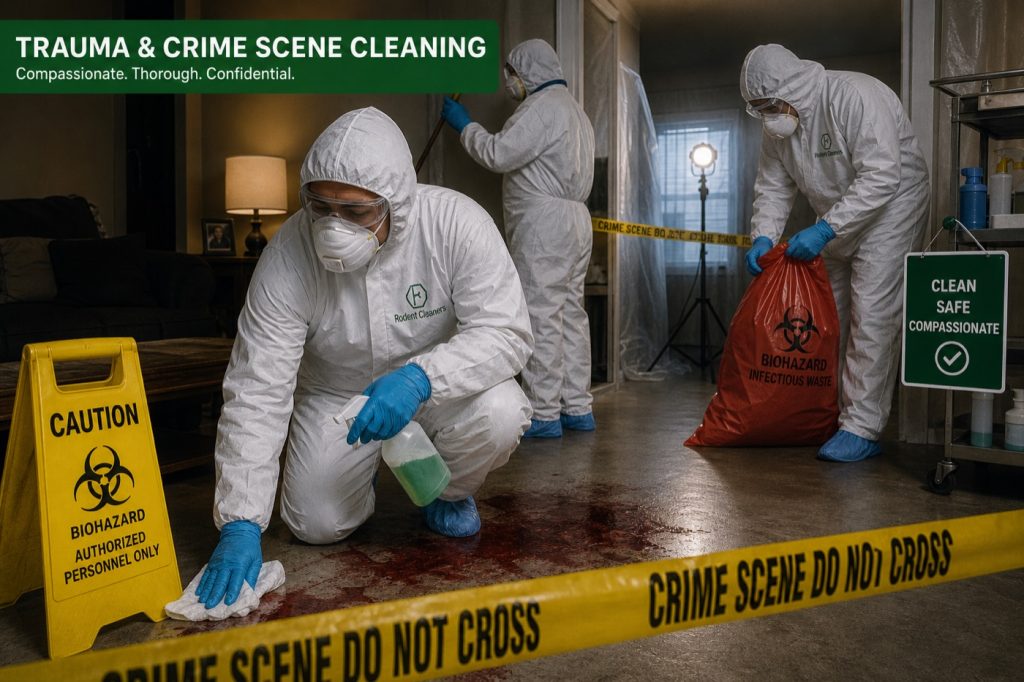
Some cleaning situations go far beyond dirt and disorder. Biohazard and trauma cleaning deals with scenes that pose a genuine risk to health, and they call for specialist training, the right equipment, strict legal compliance and, above all, compassion. This is never a job to attempt yourself. Here is an honest, sensitive overview of what biohazard cleaning involves and why professionals must handle it.
What counts as a biohazard clean?
Biohazard cleaning covers any situation involving potentially infectious or hazardous biological material. In practice that includes trauma and accident scenes, unattended deaths, blood and bodily fluids, sewage and drain flooding, infection and decontamination work, hoarding environments, and the safe clean-up of needles or drug-related waste. What these have in common is the presence of pathogens, bacteria, viruses and other contaminants, that can cause serious illness if they are not removed and neutralised correctly.
Why it must never be a DIY job
It is completely understandable to want a distressing scene gone as quickly as possible, but cleaning it yourself carries real dangers. Bloodborne pathogens such as hepatitis B, hepatitis C and others can survive on surfaces and remain infectious. Ordinary household cleaners do not neutralise them, and a domestic vacuum or mop simply spreads contamination further. Without the correct personal protective equipment, you risk direct exposure; without the right disposal route, you risk breaking the law on hazardous waste.
There is also the matter of doing the job completely. Biological material penetrates porous surfaces, carpet underlay, floorboards, plaster and grout, in ways that are invisible to the eye. A surface that looks clean can still be contaminated underneath. Professionals are trained to identify and treat the full extent of the affected area, not just what is visible.
The professional process, step by step
A professional biohazard clean follows a careful, methodical procedure designed to make the area safe and restore it properly:
- Assessment: the scene is evaluated to identify all contaminated areas and plan a safe approach
- Containment: the area is isolated to prevent cross-contamination of the rest of the property
- Removal: contaminated materials that cannot be salvaged are safely removed and bagged
- Cleaning & decontamination: surfaces are cleaned and treated with hospital-grade disinfectants
- Deodorising: specialist equipment removes lingering odours at their source, not just masking them
- Safe disposal: all biohazardous waste is disposed of through licensed, regulated channels
- Verification: the area is checked to confirm it is fully decontaminated and safe to reoccupy
Compliance and safety
Biohazard waste is tightly regulated in the UK, and disposing of it incorrectly is both unsafe and unlawful. Professional teams work to recognised health and safety standards, use full PPE and respiratory protection, follow COSHH guidance on hazardous substances, and route all waste through licensed carriers and facilities. Being fully insured matters here too, it protects everyone involved if something unexpected arises.
Discretion and compassion
Behind almost every biohazard or trauma clean is a difficult human story, an accident, a bereavement, an illness. The right team understands that. The work is carried out discreetly, respectfully and without judgement, often in unmarked vehicles, with sensitivity to families and neighbours. Restoring the space is important, but so is handling the people affected with care.
Insurance and cost
Many people are unaware that trauma and biohazard cleaning is frequently covered by home insurance policies. A reputable provider can talk you through what to expect and, where appropriate, help with the information your insurer needs. Because every situation is different, this work is always quoted individually rather than from a fixed price list.
Frequently asked questions
How quickly can you attend a biohazard situation?+
Is biohazard cleaning covered by insurance?+
Will the clean-up be discreet?+
Can the property be used again afterwards?+
The situations we handle most
Biohazard and trauma cleaning covers a wide range of circumstances, and each is approached with the same care and rigour. Among the most common are unattended deaths, where decomposition requires thorough decontamination and odour removal; accident and trauma scenes involving blood and bodily fluids; and sewage or drain flooding, which contaminates everything it touches with harmful bacteria. We also handle infection and decontamination cleaning, the safe clearance of hoarded properties where biological hazards have built up over time, and the careful removal of needles and drug-related waste. Whatever the situation, the priority is always to make the space safe before anything else.
What can be saved, and what cannot
One of the hardest parts of any biohazard situation is deciding what can be kept. Non-porous items and surfaces, sealed floors, glass, metal and many hard surfaces, can usually be cleaned and fully decontaminated. Porous materials that have absorbed contamination, such as carpet, underlay, mattresses, upholstery and sometimes sections of flooring or plasterboard, often cannot be made safe and must be removed and disposed of correctly. A professional team will always try to preserve what can be saved, especially items of sentimental value, while being honest about what genuinely has to go for health reasons.
How long does a biohazard clean take?
The honest answer is that it varies enormously with the nature and scale of the situation. A contained incident might be resolved in a few hours, while extensive contamination or a hoarded property can take considerably longer and may involve more than one visit. What never changes is the methodical approach, assessment, containment, removal, decontamination, deodorising, disposal and verification, because cutting corners on any of those stages is exactly what leaves a property unsafe. We will always give you a realistic timescale once we have assessed the scene.
If you are facing a biohazard or trauma situation, you do not have to handle it alone. Call our team any time on 07763 803002 for a fully insured, compassionate 24/7 response, or contact us here.